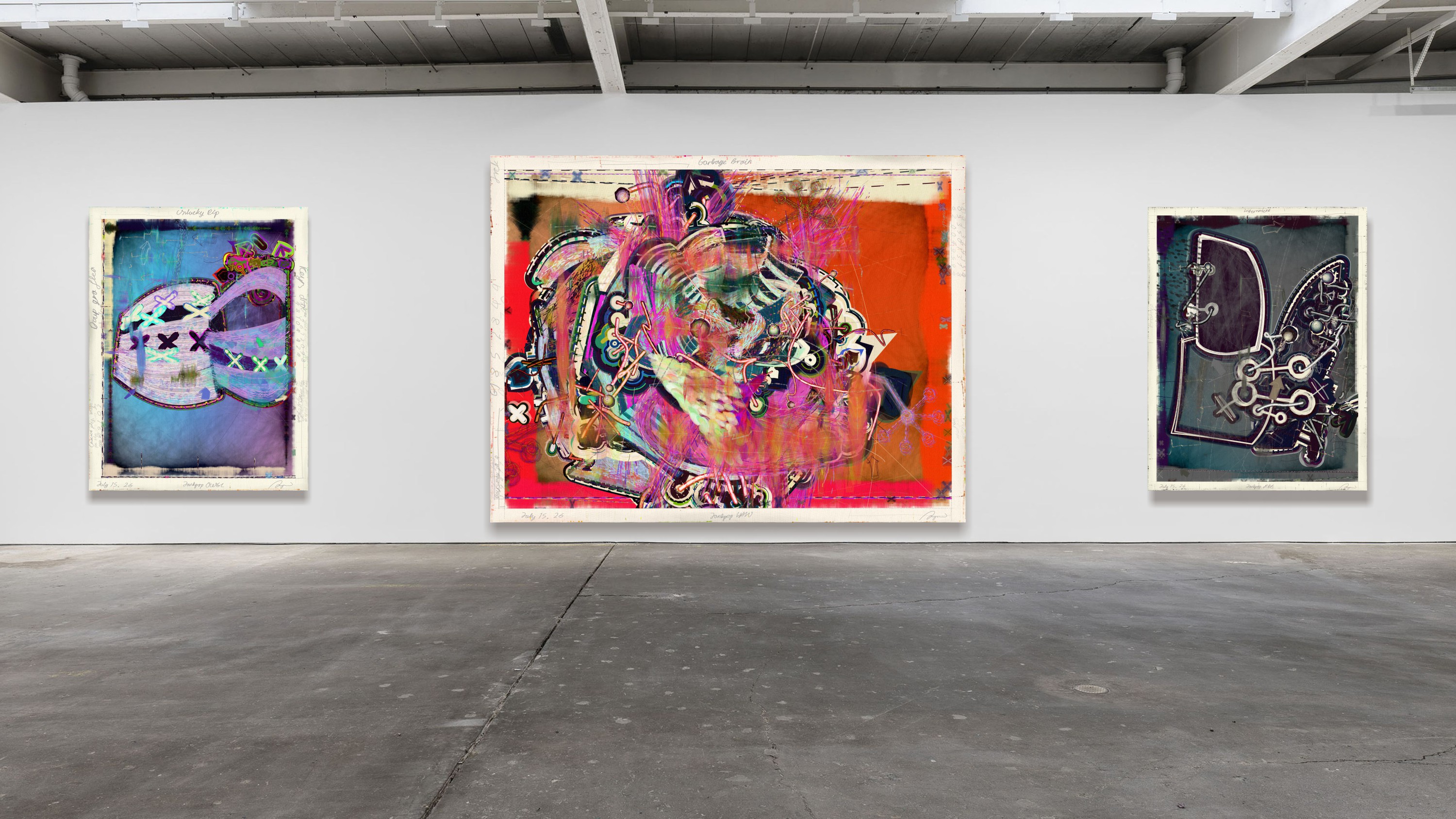
Hyper-distraction code-painting studies
555 Unique Titles
Together the titles can be seen as the tragic inner-monologue of an insecure, self-scathing and neurotic Jankist artist battling against a world of AI-uncertainty, hyper-distraction and attention-economics. Jankpop taps into the chaotic brokenness and fragile loneliness of souls that become too deeply dependent on online communities and anesthetized by the endless torrent of information consumption. There might be a real cost to the experiment many of us are participating in, which will not be revealed for generations to come.
Jankpop, Avant Gay and AbEx
Avant Gay
Avant Gay might be where the real punk movement within digital art is emerging right now. It is raw, expressively powerful and is proud of its lack of etiquette. It's playing by its own rules. To me, it feels like it's being created by real grassroots artists, not by market strategists or tech nerds. Nor does the culture feel corrupted by inflated pricing, or overly lofty curation.
Jankpop and Avant Gay
Without pretending to be Avant Gay, Jankpop is my own code-art response to this evolving creative energy blended with my long held fascination with mid 20th Century Abstract Expressionism. I want to make work that reflects the frenetic turbulence and hyper-distraction of being a human in the age of digital information with all its challenges. I feel the Avant Gay movement also reflects this uncharted challenge and assault on our psyche. Gay NFTs however are layered with rich internet references, cultural artifacts and esoteric knowledge.
Jankpop and AbEx
Although I tackled figurative symbolism with chatFUKR I wanted this project to remain principally abstract because of my deep affinity for Mid Century Abstract Expressionism. Although AbEx said what it had to say over half a century ago I feel code-art offers a new way to revisit the core energy of that movement. The context and conceptual framing is of course different, but the raw visual violence of that period is something I feel has relevance again today. In a sense I see myself as an AbEx revivalist on a course of hard Gay NFT steroids.
Practice Notes
Code Painting as Old School Technology
JavaScript, the programming language I use to make art, is now over 30 years old. Code based algorithmic art emerged 50 years prior to that.
Paint, brushes and canvas is a technology that’s been around for centuries and yet painters continue to extend the possibility space of the medium.
I feel there is beauty and even an artistic advantage to using well established or even obsolete technology to make art. Personally, not chasing the ever changing cutting edge of technology enables me to just think about picture-making which is really 90% of what I care about.
Thoughts on Code as a Direct Craft and AI
The most direct way for me to think about my art is algorithmically. Code is the most direct way for me to craft mark-making and composition. There is no way for me to explain to AI in natural language what it is I want to do. Besides, the actual act of coding has never been a bottle neck in my practice. It's also a process I love so there is not even a desire to offload it even if AI could do it for me.
A craft is a feedback loop. The medium an artist works with provides feedback about how to proceed. Art is a product of a dance between artist and medium. If I used AI then there would be a black box in between me and my intention. I touch the canvas through the code. This is a direct craft just like drawing and painting.
When I used to paint, I loved the act of painting. When I make ceramics I love the interaction with the clay. I use AI to help automate printing and learn more about efficient coding, but thus far I've had no desire to invite it into my real practice.
Making art has nothing to do with increasing productivity, it is about slowing down and becoming intimate with your process and medium.
BTW, I don't see AI art as being more or less inferior. It's just a different medium. Luckily, every artist is free to find the mediums that resonate with them.
Art and the False Reward of Productivity
Anyone who spends a lot of time creating will know deeply how limitation and constraint are keys to expression. They will know how slowness, meditation and contemplation are powerful gateways to understanding ourselves and what it is we actually want to say through our creativity.
People who get excited by the promise of 10x productivity offered by AI, I imagine see this as translating to 10x profit. Maybe that’s true if you are in the business of mass production or scaling generic services.
10x productivity however, to many true creatives will seem like the very antithesis of what they want from their practice. Having 100 fingers would not be a guarantee of making more meaningful and beautiful music on the piano. More choice offered by more powerful tools can often be paralyzing and fundamentally unnavigable. It’s much better to have a clear sense of what it is you want to say than endless options of how to say it.
Art of the Age of Code
Every age has its own art. For me, the age of [the Internet, algorithms, AI and the blockchain] can most directly be encapsulated with code. Code is the operational layer of all these technologies. Working directly in this layer seems to be the most obvious place to open new frontiers in the space of conceivable art.
Just Looking — Thinking is Overrated
The technicalities of my work are not the hard part or even the time consuming part of my practice. Probably over half of my time in my studio is spent just looking and building an intuition of how to proceed. ‘Just looking’ is the key to my practice. This means looking without thinking, without intention, without judgement — nothing to gain, nothing to lose, just looking.
Programming is always subservient to visual intuition and emotional impulse.
My practice isn't an intellectual exercise in the same way falling in love isn't an intellectual exercise. You cannot reason yourself into or out of love, and you cannot reason yourself into making images that genuinely move you.
The Internet as Medium
Long-form generative art is often described as code.
But code is only part of the story.
The medium exists because of the accumulated evolution of the internet itself.
- Web1: HTML, Canvas, JS, WebGL, SVG, Gif
- Web2: Online community participation, social media, modern browsers, simple UIs and UX
- Web3: NFT protocols and markets
Long-form generative art is the product of all three.
It represents, to me, one of the purest artistic expressions of the internet age.
Related:
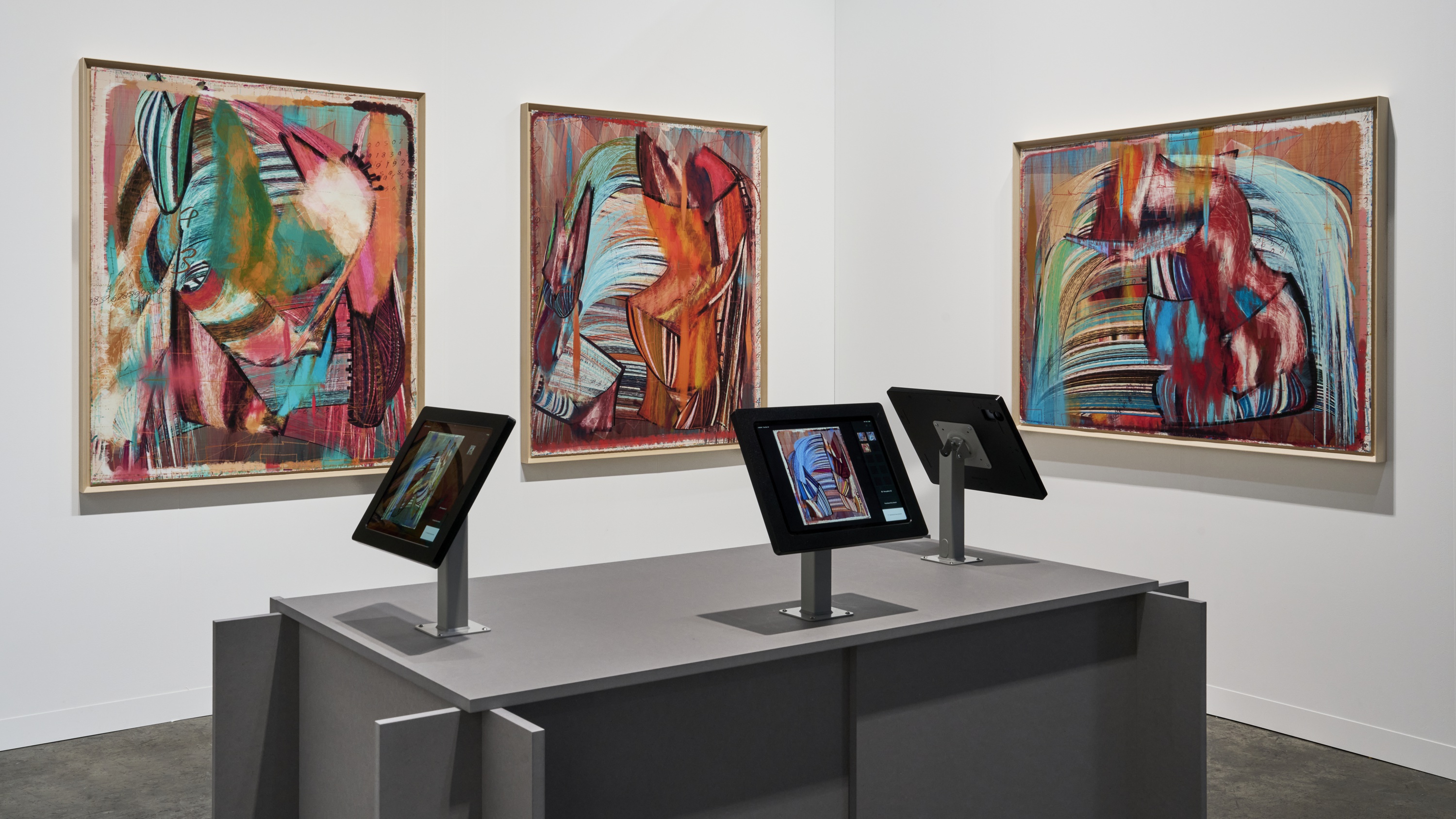
IRL Collector co-curation code based Expressionism
For Zero10, Art Basel Hong Kong 2026 we are building an experience which we hope will resonate with a wide audience who know little to nothing about algorithmic art and or digital assets.
How it works:
Visitors are able to generate unique artworks through an intuitive interface, shown in the context of large curated prints from the same system. Participants can select a favorite result to mint to a custodial wallet and collect a small, but high quality on-demand print, signed by the artist.
The experience, name, and description of this project are designed for audiences with little or no prior exposure to code-based art. The interactive component helps visitors build an intuitive understanding of the practice and how it connects to the broader history of art made with traditional media. I believe that when work does not obviously appear to be created through an abstract process like code, it can spark a natural curiosity and openness in those new to this form of digital art.
The idea of co-creating and owning a unique artwork at an accessible price point is nothing special in our space. But this, I believe, is still one of the real radical innovations offered by long form generative art in the context of the traditional art world. This project is in no way trying to push the boundaries of code-based or digital art. It is a project designed to bring some of the magic we all take for granted to a general art appreciative audience. I believe there are many innovations we take for granted in this ecosystem and forget 99.99% of the world still knows nothing about them. Careful framing and delivery of these technologies, modalities and ideas is key to bringing our art to a wider audience IMO.
Intro to the Works and Process
Rayner works with the medium of computer code and mathematics to express human emotion: an unlikely approach to a heart led artistic practice. However the artist insists algorithmic art is a direct craft, even a modern extension of drawing and painting that can be explored with expressionistic intent.
Visually, there are few things that express emotion more than the movement and poise of the human form. Social and survival imperatives have led to us evolving a heightened sensitivity to body language and gesture.
Algorithmic Synesthesia is an attempt to create a visual language from the abstracted geometry of posture and gesture. Reimagining the gestural mark-making of De Kooning and Bacon through algorithmically authentic processes.
Central to the compositions are voluminous stacked forms inspired by Moore and Léger's cubist figures which press and recoil in convulsed poses. Shrouding and veiling these assembled figures are cascades of color. Rayner envisions these as great lamenting outflows.
Color in these works is treated like an elemental force. Seen at large printed scales, the uncontrived graphic building-blocks revealed in vivid pigments are bold and unapologetic. This rawness is an analogue of thick painterly brush strokes that on close inspection brings the viewer back to the truth of the surface and the reality of the process.
At its deepest level all color and form in these works are algebra, logic and geometry. Participants at Art Basel are invited to co-create never-seen-before artworks by effectively seeding the art-making process with random numbers. The result is a kind of collective synesthesia where numbers have a direct expression as form, color and texture, experienced through the artist’s vision defined in code.
Related:
Secondary
Mints from Art Basel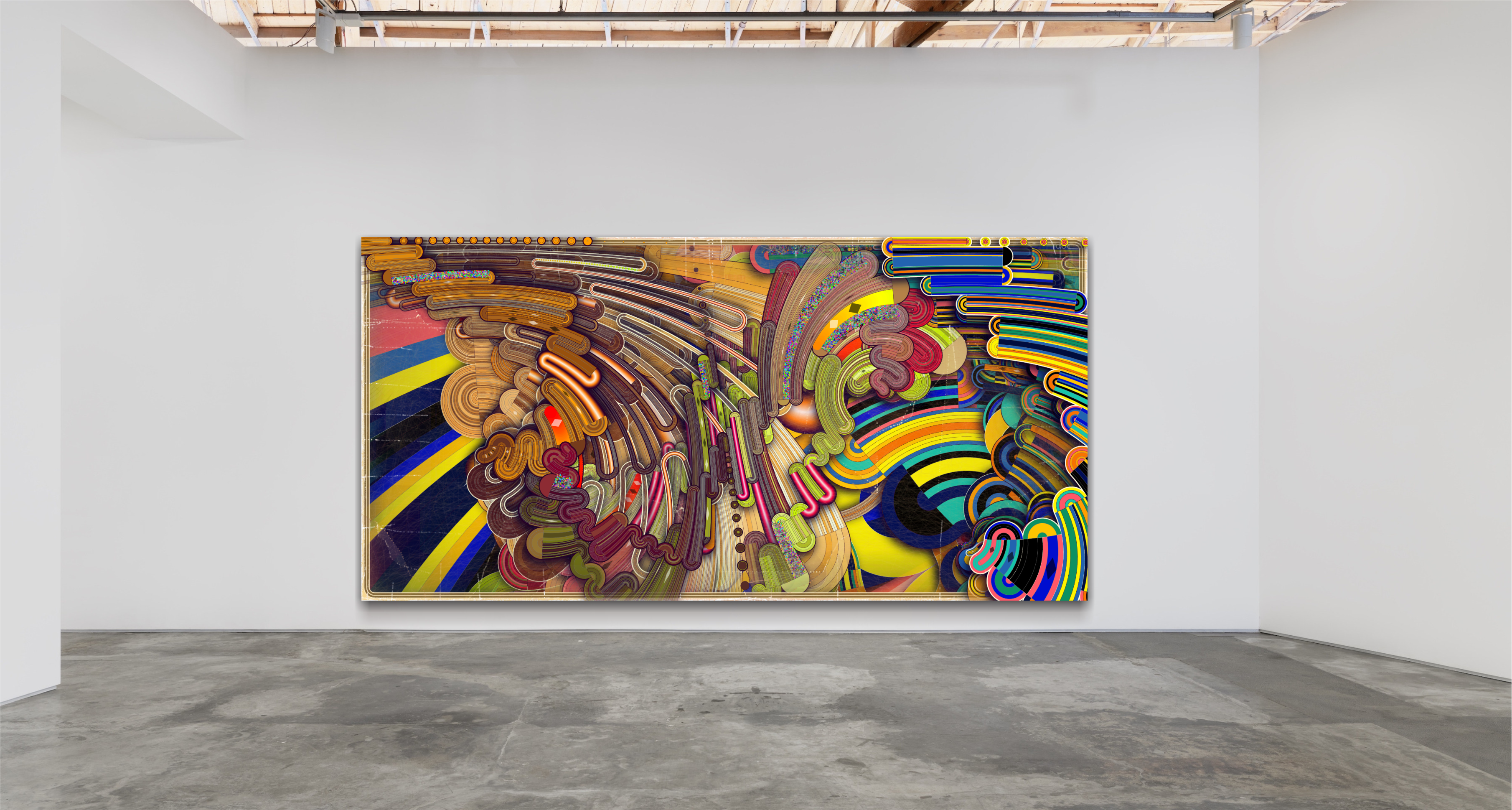
Work in progress
Abiding drivers of art markets are wealth and status signaling, glamor, gambling and of course beauty and finesse. However, gambling and wealth flexing is often not openly discussed in connection to blue-chip art when it is being shown and sold. It is often the elephant in the room. Monte Carlo is a light-hearted attempt to build a visual language that evokes a romantic stylization of that elephant. Evoking vintage glamor, 1970s Grand Prix, Monaco Casino and James Bond Ritz all in a language that feels techno and native to the crypto focused ecosystem in which it lives. The work is a visual celebration of an undeniable aspect of the Art market that's both easy to love or hate, but hard to be real about. The retro stylization is a way to put some distance between us and what would otherwise be an expression of casino bling and shameless ostentation. When it has a nostalgic patina, somehow it feels more tasteful, sophisticated and civilized.
| Where: | Art Blocks Studio Post Params |
| Sales model: | Similar to Amplitudes of Canvas |